Happy New Year in the Year of the Snake,
It has to be “Deepseek” and “Nezha”!
As it expands rapidly around the world,
I was lost in thought with him.
With the acceleration of urbanization and digitalization, the water management model has accelerated the exploration of upgrading efficiency, services, data, decision-making, and prediction. It has become urgent to use big data to supplement business support and predictive maintenance. Today, let DeepSeek perform reasoning and analysis on our smart water affairs. As a participant in smart water affairs, does this resonate with us?
(The following content is generated by AI for reference)
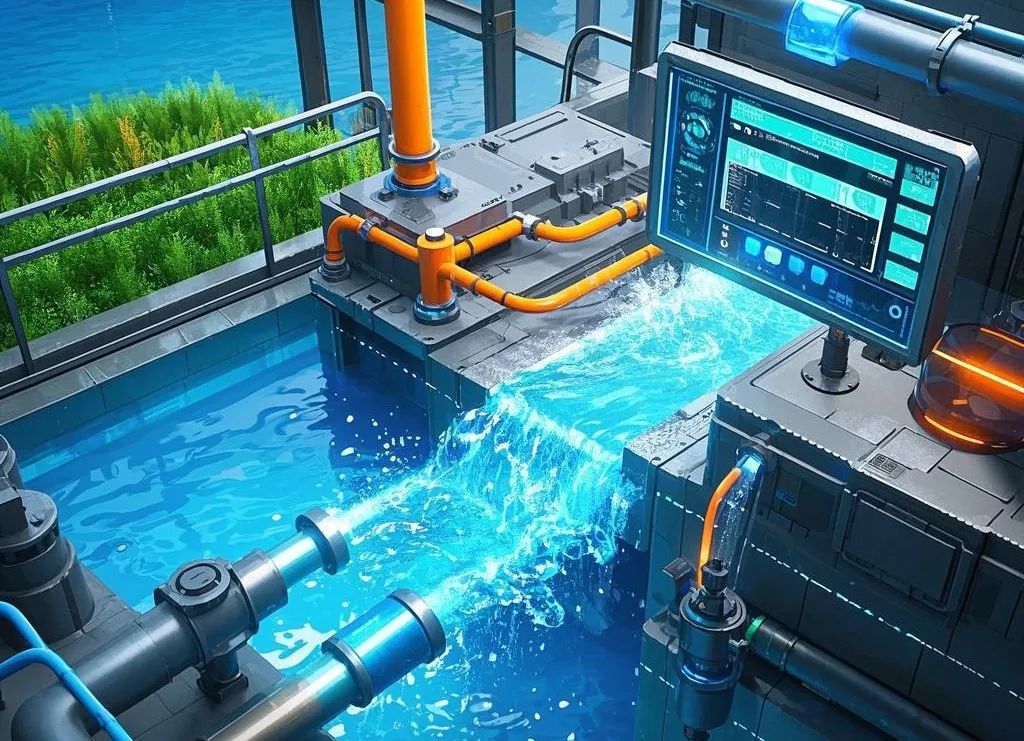
The pain point of smart drainage is essentially the technology-management-society coupling challenge in the transformation of complex systems, which needs to be broken through through the dual-wheel drive of “digital twin + system reconstruction” rather than simple technological upgrades.
(The following content is generated by AI for reference)
(The following content is generated by AI for reference)
Let’s take a look at
Deepseek’s enlightenment analysis of the smart drainage industry
Current situation: Traditional drainage systems have limited means of data collection, and data islands are serious, making it difficult to fully grasp the system’s operating status.
Enlightenment: Use IoT sensors, drones, satellite remote sensing and other technologies to build a comprehensive, multi-level drainage system perception network, collect data such as flow, water quality, and water level in real time, and use DeepSeek’s powerful data processing capabilities to clean, integrate and analyze data to provide accurate data support for decision-making.
Current situation: The drainage system fault early warning mechanism is imperfect, and often handled after the fact, causing great losses.
Enlightenment: Based on historical data and real-time data, using DeepSeek’s machine learning algorithm, build a drainage system operation status prediction model to achieve intelligent early warning of risks such as pipeline blockage, overflow, and water pollution, and take measures in advance to prevent problems before they happen.
Current situation: The operation and scheduling of drainage systems rely on manual experience, which is inefficient and difficult to cope with complex and changing operating environments.
Inspiration: Use DeepSeek’s reinforcement learning algorithm to build an intelligent scheduling model for drainage systems. According to real-time data and prediction results, dynamically adjust the operation strategies of facilities such as pump stations and gates to achieve efficient and energy-saving operation of drainage systems.
Current situation: Drainage system planning lacks scientific basis and is difficult to meet the needs of urban development.
Inspiration: Use DeepSeek’s data analysis and simulation capabilities to build a digital twin model of the drainage system to simulate the system operation status under different planning schemes, and provide a scientific basis for drainage system planning, construction and transformation.
Current situation: The application scenarios of the smart drainage industry are relatively single, and innovative applications are insufficient.
Inspiration: Explore the innovative applications of DeepSeek in the field of smart drainage, such as: automatic detection of pipeline defects based on image recognition; intelligent operation and maintenance of drainage facilities based on natural language processing; construction of drainage system knowledge base based on knowledge graph.
一. Intelligent prediction and simulation optimization
Based on historical rainfall, pipe network load, and terrain data, the time series prediction model is used to predict waterlogging points in advance and optimize pump station scheduling.
Through machine learning, pipeline CCTV detection videos and sensor data (such as flow and pressure) are analyzed to automatically identify pipeline damage and blockage risks and reduce manual inspection costs.
Combined with reinforcement learning algorithms, the hydraulic model parameters of the drainage network are dynamically optimized to improve simulation accuracy.
二. Ways to Solving Industry Pain Points
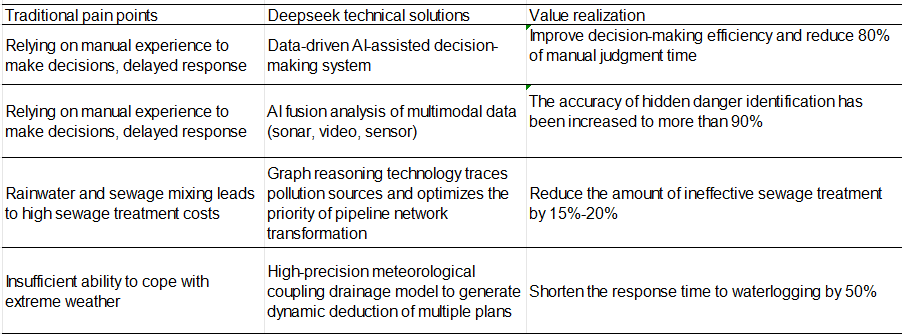
三. Future trends: the transition from “perception” to “autonomous decision-making”
deploy lightweight AI chips on drainage manhole covers and pump stations to achieve localized real-time analysis (such as video water accumulation detection) and reduce cloud transmission delays.
build a knowledge graph of “fault-cause-solution” for drainage systems, support intelligent question-answering and maintenance suggestion generation, and reduce the experience threshold of technicians.
through multi-agent reinforcement learning, realize autonomous collaborative control of pump stations, gates, and storage tanks to form a dynamic adaptive drainage network.
AI drives the “energy recovery-process optimization” closed loop of sewage treatment plants, such as improving energy self-sufficiency through real-time regulation of anaerobic digestion and methane production.
四. Challenges and suggestions
It is necessary to promote government and enterprise data sharing mechanisms and establish standardized data interfaces for the drainage industry.
solve model adaptation problems caused by differences in drainage system structures in different cities through transfer learning.
AI decision-making systems need to embed physical mechanism constraints (such as the pressure limit of the pipeline network) to avoid accidents caused by radical optimization of algorithms.
五.Summary of inspiration
The smart drainage industry needs to continue to evolve around the “data-algorithm-system” triangle architecture
In the future, the deep integration of AI and water affairs will reshape the value chain of the drainage industry – from passive rescue to active prevention, from experience-driven to scientific decision-making, and provide a key technical foundation for the development of urban resilience.
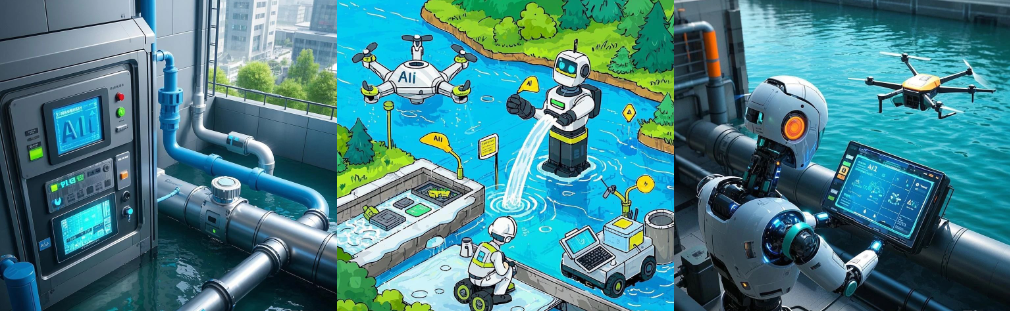
Function: Lurking in the city’s underground pipeline network, “listening” in real time through voiceprint sensors and vibration data, combined with federated learning to share leakage patterns, accurately locate millimeter-level cracks.
Anthropomorphic lines: “There is a small leak at 2.7 meters in the main pipeline of Zone 3, and the pressure fluctuation is 0.03MPa. It is recommended to repair it within 48 hours.”
Function: Based on meteorological satellites, soil moisture, and user historical data, predict the peak water demand in the next 72 hours, and dynamically adjust the water plant’s production capacity and pump station pressure.
Anthropomorphic lines: “Tomorrow afternoon heavy rain will cause the water consumption in the industrial area to drop by 15%. It is recommended to reduce the frequency of Pump Station B to 45Hz.”
Function: A group of drones equipped with micro-spectrometers patrol along the river, detect excessive heavy metals and microorganisms in real time, and store pollution events through blockchain.
Anthropomorphic lines: “COD suddenly increased 5 kilometers downstream, and the traceability track pointed to the sewage outlet of XX factory. The environmental protection department has been synchronized.”
Function: Optimize the sludge dewatering process in the sewage treatment plant, AI controls the centrifuge speed and reagent ratio, and reduces the sludge moisture content from 80% to below 50%.
Anthropomorphic lines: “Today’s sludge has a high organic matter content. It is recommended to increase 0.2g/L cationic PAM, which can save 18% energy consumption.”
Function: Generative adversarial network (GAN) simulates urban rainstorm scenes, automatically designs permeable pavement and rain garden layout, and reduces the risk of waterlogging.
Anthropomorphic lines: “Increasing 3% of sunken green space in area A can reduce peak runoff by 22%, and the cost payback period is 4.2 years.”
Function: Coordinate drainage pumping stations, river gates, and underground reservoirs during floods, and achieve global optimal scheduling through multi-agent reinforcement learning (MARL).
Anthropomorphic lines: “Start storing water in the underground reservoir of Area C, open Gate No. 3 to divert floodwater, and the flooded area is expected to be reduced by 65%.”
Finally, DeepSeek has brought new development opportunities to the smart drainage industry. By deeply integrating AI technology with the drainage industry, it can realize the intelligent and refined management of the drainage system, improve the operating efficiency and service level of the drainage system, and provide strong support for the sustainable development of cities.
Post time: Feb-25-2025